Showing posts with label writing. Show all posts
Showing posts with label writing. Show all posts
Monday, July 15, 2013
Quitting Facebook
Facebook has become unbearable to me, so those who connect to me there might want to know I'm off it. Temporary or permanent break, dunno.
It has major privacy issues but i am one of the lucky ones who read a post from a friend 13-14 years ago, a post to a group we were both in, that explained how completely public everything you do online really is, how impossible to delete, how searchable, etc. I guess I have never expected anything else, and am so in the habit of keeping that in mind that it always kind of surprises me when others are so blown away about the discovery that their privacy is nearly nil. I kinda don't care how public my posts and comments are, because I always write them with that expectation.
But. To be on Facebook is practically to enlist in an culture-war army, an army of Here Is What You Are Supposed To Think. All day, and I only have about 55 active friends, the liberal and conservative posts spool and spool, and I mostly hate them all.
The Martin case has done me in. I agree with much of what is said about the outrage that GZ committed, and STILL, STILL, I find that highly intelligent, highly educated friends who have demonstrated many times that they have complex and nuanced responses, are endlessly reposting multiple 2-dimensional lauds of Sweet, Innocent Martin on a sainthood fast track that will have him canonized long before John Paul II gets anywhere near his own. I am BLOODY fed up.
It's not all. There are family conflicts - distant family - going on right now and I can't even hide the culture-war junk and post about real life matters. I weigh every word, I worry how it will be read, or used, even when it's an inspirational quote or a book recommendation, I can't even be that self-edited milder version of myself there anymore.
Online life is stressful. There are ways around offensive spam and offensive ads and Cardassians, but online life is a constant battle as each victory gets blocked, and the spam/junk purveyor creates a workaround; new defenses need to be employed, always a need to maneuver and cut off and reposition to attack again. It's like an old Mad Magazine piece from my youth, "Recruiting posters from history" that had one poster saying "Enlist now in the 100 Years War!"
I like so much of what the net has to offer. We have an online business, plus there's wonderful stuff to fnd. I'm not willing to go back to 1970 tech. Much of the battle against awfulness, I have to fight, but Facebook is one BIG battlefront I can at least take a major break from.
Back to blogging, maybe more of flickr (despite its changes) or Pinterest. In the blog world I can read who I want to read, I can respond to people, I can write, certainly not much personal stuff -- same problem I have on FB -- but any musings I want to share, with a hair more control over their permanence and audience. I know; not a whole lot, but some. Writers need outlets.
None of the above right now. I'm tired.
But I'm still here. See yall around.


Tuesday, November 01, 2011
Third grade - peace, love, commas
 |
| My elementary school, photo taken 1999. |
Writer Natalie Goldberg has advice for writers and blogger Xtreme English posted a passage from it, which included some writing exercises. And THANK YOU, XE, it's wonderful advice, plus it got me started on one of Goldberg's exercises; to write everything you remember about third grade.
Third grade for me was the 1962-3 school year, and my first thought about the Goldberg exercise was that third grade was a big nothing. Any interesting events, any particularly good or bad teachers, came in other years, so Third was notable for not being notable.
About 18 years ago, when I was in a writers' group, I wrote a nostalgic essay about 1964. I posted it to this blog (wow. 4 years ago!). It's here if you want to read it (or read it again) but I never felt happy with it, and later, realized it was not only kind of substandard, but actually inaccurate.
I certainly wrote it honestly -- i.e., that was how i remembered things -- but that memory of 1964 being the last serene summer before awful life events changed our world was false. In fact, Sally and Patsy's father died in the same fall of 1963 that Kennedy was shot, and that next summer was about trying to regain "back to normal" feelings like we'd had before, not a time of still having them for real.
The calm year, the real last-year-of-innocence, was third grade, fall 1962 through spring 63.
 |
| Nostalgic visit to the primary-grades building, 1999. The 3rd grade wing is behind me, up the hill. That hill was much higher in 1962. |
Third Grade was a big rite of passage at my elementary school, because we moved up the hill. The school sat along a hilltop that looked enormous to me then. Grades 3-6 were all in one L-shaped building, with the primary grade building beneath and behind it, down a hillside flight of stairs. Of course we hiked up and down the concrete steps to library and cafeteria sessions, but our home base as 1st and 2nd graders was the bright little-kid-oriented rooms.
When I walked into my assigned Third Grade room, I got a clear message that sunny Primary life was over and we were getting down to serious business. Intimidating maps and historic portraits on the wall portended demanding studies. No more bright paint. No long wall was devoted to a window looking out at the leafy world. Upper class schoolroom windows started at the shoulder height of taller kids. Rows of worn readers that we were expected to use for self-improvement when we finished an assignment with time left, and sets of occasional-use books ("Now, would Ricky and Karen please pass out the music books?") filled shelves underneath it. My class met in a blue-gray room that sun rarely touched.
And this year, we'd get grades. Not just checkmarks in Fair, Good, Swell categories, accompanied by narrative about our effort and attitude, but A, B, C ... and other, unthinkable letters. The year started, as they all did to some degree, with stomach-knot anxiety about what would be demanded of me.
And, as they all did, it turned out to be just more school. We had a nice enough teacher and a year without drama. I got good reports at the first two quarters. I felt more relieved than proud, or even interested. An achievement ethic wasn't in me yet.
Which is why, at the third quarter report, I was stunned to see straight A's down the column.
I hadn't tried for those, or any, grades. I worked because it was assigned, though I put more into it when the task interested me. I thought of report cards much the way I thought of bubble gum fortunes. You opened the paper, you saw what had been declared for you.
I wasn't much into thinking ahead. This was the year I put a leftover half of a peanut butter sandwich in the back of my desk and forgot about it until clean-out day before Christmas break. It was barely recognizable, stuck to its wax paper with green mold.
But third grade was the year of punctuation. I mean, serious punctuation; quotation marks, complex sentences with commas.
I hung onto every word. This was something I wanted. These were the writer's tools for expression and clarity. I might not have mastered clarity yet, but I got pretty good at commas.
In fourth grade, big things happened, in the neighborhood and in the world, but in third, September to June ambled through their mundane lessons and vacations and seasons. It was the last year of my unshaken life. After my friend's father committed suicide that fall, and the President was shot and killed, the world never again seemed trustworthy, but in Third I had the tranquility to let me take an interest in a subject for its own sake. Which was pretty cool.
Thursday, August 11, 2011
I could dust something off...
I have a bunch of drafted posts waiting to be rewritten into publishable states. But I'm not going to work that hard. Instead, I'll ramble.
My novel is also stalled. All it "needs" is proofreading that I've realized I'm incapable of doing because I'm too familiar with it and my brain just slides past goofs. I put "needs" in quotes because my opinion of the basic story, characters and execution is merely that of the author and not sufficiently objective, so my belief that it needs only proofreading could be total brain-goo. I'll be hiring a real editor when I can afford it, but not before.
My review of The Dry Grass of August (which I wrote about on this blog awhile back) is now up, on the book blog.
So is an overlong (but I cut a fourth of it!) treatise on women in the 1920's, as depicted in a few popular fiction books I know of.
I haven't been announcing book blog posts. A new one appears on occasion.
I'm finding Real Life hard to write about lately. Mostly because its uneventful, and that's very very good. Enough with Events. It's not a terribly happy time, but actually, a good part of life in some ways. This year+ since Mom got sick has been, and keeps being, an Opportunity For Growth.
I'm fed up with Facebook. I post only selectively, and post links to articles or fun things only if I really think they're interesting to a wide swath of my "friends" but get practically no indication that they were seen. And I've realized what most people -- really, I do think it's most -- use Facebook for. Their egos. They amass 200+ friends and immediately click each one and choose "Hide all posts by soandso." Then they themselves post, and bask in the "likes" and attention and discussions they spark, but care not a bloodyblue screw what you have to say if they are not the center of attention. A website that used to tell you who had your posts blocked has been taken down. Man, them facebook moguls sure have got some kind of far reach. So FB has become the ideal way to
A. promote yourself, I guess. Unless everybody's blocked you.
And...
B. claim your friend list is terribly diverse, while you make sure you never hear anything you disagree with.
Facebook is a major player in the complete divide that's happening in the U.S. No information sources for the general public, just a batch of resources each dedicated to their own viewpoint, and to making sure their members preach only to the choir and act as good choir-members to others they already agree with. Facebook has brilliantly managed to become a way to be a source for all sides while letting each member silence all diversity and stew only in his/her own pot. You can hear only liberals, or only conservatives, or new-agers, or atheists, or fundamentalists, only whatever you're into. No wonder it's taking over the planet.
Plenty of other topics coming, when I get them ready.
My novel is also stalled. All it "needs" is proofreading that I've realized I'm incapable of doing because I'm too familiar with it and my brain just slides past goofs. I put "needs" in quotes because my opinion of the basic story, characters and execution is merely that of the author and not sufficiently objective, so my belief that it needs only proofreading could be total brain-goo. I'll be hiring a real editor when I can afford it, but not before.
My review of The Dry Grass of August (which I wrote about on this blog awhile back) is now up, on the book blog.
So is an overlong (but I cut a fourth of it!) treatise on women in the 1920's, as depicted in a few popular fiction books I know of.
I haven't been announcing book blog posts. A new one appears on occasion.
I'm finding Real Life hard to write about lately. Mostly because its uneventful, and that's very very good. Enough with Events. It's not a terribly happy time, but actually, a good part of life in some ways. This year+ since Mom got sick has been, and keeps being, an Opportunity For Growth.
I'm fed up with Facebook. I post only selectively, and post links to articles or fun things only if I really think they're interesting to a wide swath of my "friends" but get practically no indication that they were seen. And I've realized what most people -- really, I do think it's most -- use Facebook for. Their egos. They amass 200+ friends and immediately click each one and choose "Hide all posts by soandso." Then they themselves post, and bask in the "likes" and attention and discussions they spark, but care not a bloodyblue screw what you have to say if they are not the center of attention. A website that used to tell you who had your posts blocked has been taken down. Man, them facebook moguls sure have got some kind of far reach. So FB has become the ideal way to
A. promote yourself, I guess. Unless everybody's blocked you.
And...
B. claim your friend list is terribly diverse, while you make sure you never hear anything you disagree with.
Facebook is a major player in the complete divide that's happening in the U.S. No information sources for the general public, just a batch of resources each dedicated to their own viewpoint, and to making sure their members preach only to the choir and act as good choir-members to others they already agree with. Facebook has brilliantly managed to become a way to be a source for all sides while letting each member silence all diversity and stew only in his/her own pot. You can hear only liberals, or only conservatives, or new-agers, or atheists, or fundamentalists, only whatever you're into. No wonder it's taking over the planet.
Plenty of other topics coming, when I get them ready.
Saturday, May 14, 2011
Detective work on a family mystery

My grandmother wrote a unpublished novel, and a bunch of short stories that did get published. Holland's: The Magazine of the South, Farm & Fireside, and probably others paid her nicely for her work.
I say "probably" others because she had an almost pathologically self-deprecating tendency to throw away her courtesy copies.
Bless him forever and ever, my grandfather often rescued the magazines from the garbage and hid them away. In 1984, when Gran had passed, my mom and I found them secreted among stuff on high shelves in odd rooms of their house. That's what's left of her body of story work, in the top photo.
The confession stories were the ones my grandmother was the most ashamed of. She said they were trash, and while she wrote them strictly for money, it appeared that she even felt bad about taking the money.
I well knew she was always hard on herself, but this seemed oddly extreme to me.
I tried to figure it out. Even confession stories presented positive enough values and uncompromising consequences for wrongdoing. Hers would be classy, I was certain. Maybe she felt bad about encouraging readers to even buy these magazines and be exposed to the lurid parts. Maybe the whole idea of fiction being sold as fact bothered her. I could kinda see that, and I understood the low status of trashy fiction for the time, but 30, 40 years later she still wanted to erase that part of her history, and seemed unhappy that my mother had even told me about it. What the...?
Anyway, I thought they were lost forever. But my grandfather must have stashed away one of those, too. There are multiple copies of the 2 mainstream magazines that mom uncovered in the old farmhouse, but I had never seen that True Story issue -- the one on top of the stack -- until a frikkin WEEK ago, when I found it in a drawer with the others.
Unlike the others, it's a wreck, tattered and flaking, and it's almost impossible to turn the pages.
But within an hour of finding the one in Mom's drawer, I was back here at my computer, and had bought and paid for a relatively nice copy from an eBay seller! God, the internet is so full of crap and misinformation and identity-thieving and data-mining and utter obnoxiousness..... ARGH, but sometimes it's the best thing that ever was :

True Story - November, 1930!
Now the hard part.
Confession stories, at least back then (maybe now?), carried no author names at all, even pen names. They were usually written in the first person which created an illusion of personal info-sharing. Because they were complete fiction.
While my dear grandfather had enough thought for her legacy to preserve the tattered copy above, he apparently did not go so far as to realize that family 80+ years later would need to know which was hers. Or maybe he marked it on the Contents page, but that page is now missing.
ARGH to the 2nd frikkin power!
Looking through the stories, it's a process of elimination. The $2000 and the $1000 prize stories?

Highly unlikely. If she'd won such a gargantuan fortune, that would have become family legend no matter what she wanted. So I eliminated those two.
Eliminate settings involving cattle ranching or olive growing in Spain. She could certainly research anything but I'm 99 % sure she didn't bother when she could write what she knew, and that was country people and country problems.

Eliminate anything about lust or mobsters, because she would never be un-classy, plus mobsters, and urban settings, weren't what she knew. Everything of hers that we do have was rural. Southern rural, but for confession stories, I won't completely discount a midwest farm story, when the plot concerns the people and not the particulars of plains farming.
The tragic honeymoon story is kind of amateurishly written, plus it's sort of pointlessly dead-honeymooner depressing and that's not her style. Anyway, it's about Rocky Mountains camping.
So I winnowed it down to these two. The Prodigal Son story ....

And the... other one.
And I'm pretty sure it's the other one. The prodigal son story is the midwest farmer one. It's countrified enough and carries her values, AND involves tuberculosis. She'd had one TB scare in real life by then and was always watched for signs of it, so it would be much on her mind. But it's drearily repetitive, and has a long story-within-the-story that's too detailed and mawkish. It isn't well-constructed enough for a novelist whose novel was very seriously considered by a major publisher and was nixed only for being too sad in 1931. She, as should be obvious by now, would never brag on herself, and she's the one who told me that the publisher's letter praised the novel.
Still, maybe lousy writing was the reason she loathed her short story so....
But! this one said "Bingo!" to me as I read it.

Despite its melodrama, it's well-written enough to be kind of touching. The girl who erred is relentlessly Noble, but it's a pretty realistic story about what happens to a woman in the early 1900's who has a baby out of wedlock, and the lifetime of self-abasement she, not so much undergoes (passively), but puts herself through if she's a good woman. And it's about her being a good woman.
Spoilers (because it's a lo-o-ong story in tiny print and hard to scan): Our heroine, 17-year-old Margaret, tells the story of Anna, who comes to keep house for Margaret's family after Anna's baby dies at birth. Margaret is in love with Christopher and comes to realize that Christopher fathered Anna's child.
It takes a few years for Margaret and Christopher to marry, and first they have a very open conversation about it, more honest about life's messiness than stories you'd get in Redbook at the time. The writing is good until the silly ending in which Margaret and Christopher find out that the child did not die, but inherited her long-suffering mother's beautiful voice and became a light opera star. Confession magazines required such Stella Dallas-y stuff and I expect Gran hated writing the big tearful Reveal to give the story commercial edge in a highly competitive market.
Clues that this is her story:
The heroine is the oldest of a brood of kids in a happy family. My grandmother was too. And Gran's youngest sister, about (?) 14- 15 at the time this was written, was surely known by the family to be just such a talented singer as the girl in the story. My great aunt did have minor success regionally before quitting to do the marriage thing.
A minor character has a name that's connected with our family, an unimportant clue except as part of the whole pile of clues. The heroine has to say goodbye to the man she loves for awhile, as he goes off to make a career for himself. My grandmother did this every week while my grandfather was on the road as a traveling salesman. The couple in the story love each other deeply and reconcile themselves to reality. Yep.
Adding up: the realistic yet very compassionately handled subject; the probability that Gran mined some sad local out-of-wedlock situation for her plot; and the melodramatic exposure-of-secrets tie-up at the end, required by the confession genre .....
I think this is her story, and that these are the reasons she wanted to disown it, even though the check it brought in probably meant they could now buy a mule for the farm. In her mind, she'd not only added bad melodrama to sell it, but, much more importantly, she'd used someone's tragedy to make money. I knew her and that would explain it.
And it's still a guess! A good guess, but a guess.
I feel like I spent the day having a long heart-to-heart talk with my grandmother. If this is her writing, both the story and her feelings about it tell me a lot about her. She wasn't proud of herself for this, and I understand, and yet I'm proud of her. And proud of my grandfather too, for being one of those people who preserve history when others think it's trash!

Monday, June 21, 2010
It really exists. Honest.

I won't try to pin the slowness of my completing this novel (which everybody's probably sick of my talking about, and which I'm sicker of than anybody) on all the real-life things that take a lot of my time. Some do, but I'd write at a snail's pace anyway.
It's not really a mystery story. A fairly attentive reader could figure out what the deal is very early, and that's the way I wanted it. But it's a plot with mystery elements, where events have to hide the true nature of what's going on, and to mislead some of the characters, and, honest, I'm probably too ADD to write stuff like this. There's too much to keep track of.
Every time I polish off another draft, I truly think it's done. I print up a copy and plan to read through it for typos and minor problems, sure that they'll be quick fixes and that I'll be hitting the "Make it public" button very soon. The picture shows 4 different drafts, going back a couple years.
This print-up is both a self-indulgence -- seeing it as a real book is like a reward, and I need that reinforcement -- and useful, because it's a lot easier to edit. I can catch typos much better in this format.

But then I find, not only typos, but true plot holes. Really really bad things, like an event.... followed by a chapter describing changes caused by that event that develop over a week's time.... only I kinda forgot that I wrote the chapter to take place only a day later.
It's not that these goofs are hard to fix. They're pretty easy. The problem is that I find them after so many re-readings that I fear other screwups/anachronisms/etc., will be lurking there even when I think I've caught and fixed them all. Readers will catch them right away and say, "That's ridiculous." The New Yorker magazine will feature me in one of their "Our Forgetful Authors" dingbats....
That's a joke. Twenty people might read this book if I get really lucky.
Anyway, I thought I'd show yall, right here, the true, actual, verified existence of the thing! See? There it is! It's real. Lousy, but real. And I'm certain that this next read-through and cleanup will be the final one......
I hope. Because I can't "system restore" this miserable, soundless, freeze-and-crash computer till it's done.
Wednesday, May 05, 2010
A balanced life. Not.

I don't do those blog memes except on the rare occasion when the question(s) really appeal to me, but an individual question will occasionally jumpstart me on a topic.
This time, the Wednesday Random Dozen (link is to my friend Catherine's answers - she does it regularly) asked ten things I really have nothing interesting to say about, and two others that struck me. Though they rather annoyingly rub my face in my faults:
1. What room in your home best reflects your personality; and
2. How do you maintain a balanced life?
A what? A "balanced" life? That's one of those "shoulds" that nobody actually does, right? Like rotating your tires, or always tightening the #%$ing child-guard cap back onto the pill bottle even when there's no possibility of a small child around, instead of leaving the cap loose and easily removed.
Seriously, I guess most people try to balance their lives but I gave that up ages ago. I work best when I do one thing that I feel driven to do and neglect everything else, and then change course and do something else.
For a week now I have been pounding at the novel (remember my novel? That brick wall I've been beating my head against for over 4 years?). Nothing else. Kitchen's a mess. I've done no business work to speak of. Barely reading, not writing anything else. Just Total Immersion.
It's not a burst of writing enthusiasm. It's more that I want the blasted miserable thing out of my life. Done. Sunk into that great sea of self-published plankton, never to be seen again. My love/hate relationship with it is on the outs right now, and I'd really rather be saying something else than saying what it ... says. Not that I don't still like my basic world-view as depicted in this college dorm of 1973-4. But I've been there an awful long time.
Which brings me to Question One. My alleged office is where I beat on this and other projects, and appropriately enough, it reflects the Real Me to an alarming degree. It's a chaotic mess.
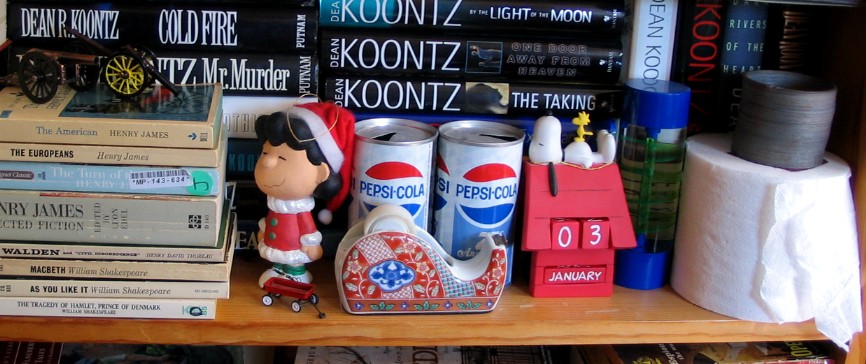
But part of the problem is tchotchkas. Knickknacks, doodads, thingamajigs. In decorating magazines, you see lots of interesting knickknacks on bookshelves, often in front of the books. You can tell that the space is staged and not designed for use. WHO wants to move a gift shop's worth of stuff to get out a book?

In real life, true Book People have a separate place for tchotchkas. I'd give anything to have one, but aside from a single dedicated shelf on which there's no more room, it's a dream for the future. I'd never have shelves like you see in this post, if there were any other place to put these things. I love my tchotchkas and the people who gave them to me. Each one has a story.

The little wooden Viking is a figure I've had since I was 7 years old. I think some classmate gave it to me for that birthday, but I don't really remember. I love it beyond all reason. The moose is a McDonalds toy from at least 40 years later but it seemed to be just what my Viking needed. Some cool little figures come with model railroad gear, and Larry gave me some that were "me" kind of things.
But they get shuffled into weird configurations as I try to gain access to what's behind them, and, just as each knickknack has a story, there's a story -- at least, a sequence of events -- behind the current position of each one, too. Not necessarily an interesting sequence, no matter how odd or amusing the final placement is. Things get bunched and placed inside other things and then moved off to any stable surface when the shelf behind them needs access.
But the process can create a weird version of Accidental Art.
Honest, every one of these nightmares of clutter that you see is exactly as it was, not staged for the photo. Many people would say, "I could not stand all that clutter!" I actually have a hard time with it too. I periodically organize. Then it slowly reverts to its natural state. These photos catch it at its end state in the process and a cleanup is called for. I see no permanent solution until I have the afore-mentioned tchotchka space. But I can cope with it. After all ....

Thursday, May 07, 2009
Ruth ... is Twitter-impaired
... is just no good at this quick-line thing. I either want to write some longwinded Meaningful Essay, or to accumulate the brief updates and post them in a big batch. It's kind of the same thinking that created the Variety Pack as a marketing device. Packaging a statement with a collection of other statements means any one reader is more likely to find something interesting in it. I'm also just no good at expressing even brief thoughts in 140 characters.
... and Larry had our 12th anniversary on April 25th, but spent it at a cousin's wedding and didn't do anything for our own until yesterday, which was a day-trip to Charleston, SC, lunch at Earth Fare, and a couple of hobby store stops. (189 characters. Disallowed.)
... bought a couple puzzles to play with and work kinks out of her brain. The tangram puzzle is kind of fun.
... found out weeks ago that my novel didn't make the next contest level, but had to wait another month to get the reader reviews, and can now fix some things in it. And found some of the entries that did make the semi-finals so appalling that I don't feel too bad about being out. Which is possibly a case of Sour Grapes that means I'm rather immature. (283 characters. Error.)
... wishes it would storm. It keeps clouding, rumbling, and then clearing, without raining. We need it badly.
... wishes that the alarming number of friends I have who need jobs would get good ones where their knowledge and skills are appreciated.
... didn't know that the metal titanium was actually found in nature. I thought it was a manmade substance. Yeah, really. I discovered this by happening across an eBay listing for a book on mining titanium ore. (170 characters. Fail.)
... wonders why the Farm Town game on Facebook does not offer a gate for the barnyard fence. I mean, what good is a fence that has no gate??
... thinks maybe I'm too involved in Farm Town.
... thinks M&Ms Premiums were invented just to torment me.
... finds having to refer to herself in the 3rd person in order to match her status statement up with the 3rd person default intro is ridiculous, and notices that nobody else does it either. (153 characters. Hang it up!)
... is going to get offline and clean up her office now.
... and Larry had our 12th anniversary on April 25th, but spent it at a cousin's wedding and didn't do anything for our own until yesterday, which was a day-trip to Charleston, SC, lunch at Earth Fare, and a couple of hobby store stops. (189 characters. Disallowed.)
... bought a couple puzzles to play with and work kinks out of her brain. The tangram puzzle is kind of fun.
... found out weeks ago that my novel didn't make the next contest level, but had to wait another month to get the reader reviews, and can now fix some things in it. And found some of the entries that did make the semi-finals so appalling that I don't feel too bad about being out. Which is possibly a case of Sour Grapes that means I'm rather immature. (283 characters. Error.)
... wishes it would storm. It keeps clouding, rumbling, and then clearing, without raining. We need it badly.
... wishes that the alarming number of friends I have who need jobs would get good ones where their knowledge and skills are appreciated.
... didn't know that the metal titanium was actually found in nature. I thought it was a manmade substance. Yeah, really. I discovered this by happening across an eBay listing for a book on mining titanium ore. (170 characters. Fail.)
... wonders why the Farm Town game on Facebook does not offer a gate for the barnyard fence. I mean, what good is a fence that has no gate??
... thinks maybe I'm too involved in Farm Town.
... thinks M&Ms Premiums were invented just to torment me.
... finds having to refer to herself in the 3rd person in order to match her status statement up with the 3rd person default intro is ridiculous, and notices that nobody else does it either. (153 characters. Hang it up!)
... is going to get offline and clean up her office now.
Sunday, January 25, 2009
Yes, I'm nuts
So there I am in December, starting the 4th draft of my novel and thinking, Hoo-boy, this is truly bad in so many ways, and the chance to enter it in a contest comes up.
Suddenly I decide that I can not only make it a not-stupid book, but that I can do it in time for an early February (!) contest deadline, despite Christmas, houseguests and everyday life. I'm now thinking I belong in lock-up. Reformatting it for the rules turned into a whole, practically line-by-line, job by itself. Finished that yesterday, and only now can I even start entering substantive changes, from typos to genuine plot repairs. Oh and did I mention that I never completed the 4th draft edit before I started the reformat work?
All for something I haven't a prayer of winning, though that's not really a self-putdown. It has as much to do with my breaking a bunch of rules about what's commercially viable, as it does with writing problems. (Oh, well, yeah and with the fact that there might be 10,000 entries!) I'm pretty much doing what I want to do, not what "the market" prefers, But I don't mean to make it sound like I'm protecting My Terribly Important Artistic Vision from being commercialized. The story is pop fiction, meant to be fun, and even then, mainly to readers who give a hoot about the issues and angst of teenaged girls. All I care about is that I get to run my fictional world my own way. If I run it somebody else's way, the book becomes just a product and I fail to have fun.
Entering this contest sort of puts the book into fitness training. I see things in my writing, when I put it into public access, that I don't see when I'm still keeping it private. Posting an excerpt awhile ago showed me a major flaw that I'd missed when I was re-reading it only for myself. This contest is another chance to make me refine the thing.
Also - I'll be able to say I gave the commercial-publication route at least one fair shot.
Anyway, that's what I'm mired in these days. I and 9,999 other people who also cherish their novels. Yeah, mine could be one of 10,000 entries in this one contest. It doesn't do to take life too seriously!

Suddenly I decide that I can not only make it a not-stupid book, but that I can do it in time for an early February (!) contest deadline, despite Christmas, houseguests and everyday life. I'm now thinking I belong in lock-up. Reformatting it for the rules turned into a whole, practically line-by-line, job by itself. Finished that yesterday, and only now can I even start entering substantive changes, from typos to genuine plot repairs. Oh and did I mention that I never completed the 4th draft edit before I started the reformat work?
All for something I haven't a prayer of winning, though that's not really a self-putdown. It has as much to do with my breaking a bunch of rules about what's commercially viable, as it does with writing problems. (Oh, well, yeah and with the fact that there might be 10,000 entries!) I'm pretty much doing what I want to do, not what "the market" prefers, But I don't mean to make it sound like I'm protecting My Terribly Important Artistic Vision from being commercialized. The story is pop fiction, meant to be fun, and even then, mainly to readers who give a hoot about the issues and angst of teenaged girls. All I care about is that I get to run my fictional world my own way. If I run it somebody else's way, the book becomes just a product and I fail to have fun.
Entering this contest sort of puts the book into fitness training. I see things in my writing, when I put it into public access, that I don't see when I'm still keeping it private. Posting an excerpt awhile ago showed me a major flaw that I'd missed when I was re-reading it only for myself. This contest is another chance to make me refine the thing.
Also - I'll be able to say I gave the commercial-publication route at least one fair shot.
Anyway, that's what I'm mired in these days. I and 9,999 other people who also cherish their novels. Yeah, mine could be one of 10,000 entries in this one contest. It doesn't do to take life too seriously!

Saturday, November 08, 2008
A veteran's story [updated]
When we lived in New Jersey, ten years ago, Larry and I started a witers' group, and one of our members was WWII veteran David Wetherill. Dave was a wonderful man and a major asset to the group.
For this upcoming Veterans' Day, Larry has contacted David's widow and received permission to publish in his Ring of Life blog a true story that Dave wrote for his outfit's newsletter, about his quest to find out what had happened to the pilot who didn't make it home when they were shot down. It moved us deeply and you guys might like it too. You can find Part One (of 2) here, along with more about Dave. Larry will post the rest tomorrow and I will link that in an update.
And by the way, Dave and Jean's daughter is the youth novelist Susan Shaw.
--
UPDATE:
And as promised, Part 2 of Dave's story, Poppy Field Found, is now up.
For this upcoming Veterans' Day, Larry has contacted David's widow and received permission to publish in his Ring of Life blog a true story that Dave wrote for his outfit's newsletter, about his quest to find out what had happened to the pilot who didn't make it home when they were shot down. It moved us deeply and you guys might like it too. You can find Part One (of 2) here, along with more about Dave. Larry will post the rest tomorrow and I will link that in an update.
And by the way, Dave and Jean's daughter is the youth novelist Susan Shaw.
--
UPDATE:
And as promised, Part 2 of Dave's story, Poppy Field Found, is now up.
Thursday, July 17, 2008
Purity
Content Advisory : this fictional work-in-progress takes place among college students in the 1970's and contains some crude language and jokes.
--a dorm in a Midwestern women's college.
The 1st draft of this passage was written about a year ago.
Somebody’s huge vase of yellow roses, bearing a birthday-themed envelope, awaited its addressee at the reception desk. She stood awash in their marzipan fragrance.
A burst of laughter brought Audrey out of her trance. She ventured around the corner, where a cheery crowd of about twenty was decorating the lounge for the Woodard Halloween party.
“‑‑need to ridicule everything.” Stephanie Anderson stood at the piano, spacing construction-paper autumn leaves along a string of red yarn, and reprimanding someone.
There was Gwen, of all people, elbows on the piano and holding the yarn’s other end. She jabbed leaves onto it with a big darning needle and slid them down toward Stephanie.
That’s right, Gwen likes this Dana Girls school chum stuff.
Others chopped leaves out of red and gold paper, using little blunt grade-school scissors.
“I completely agree. We should save it for things that need ridiculing,” Denny responded. She glanced up from her task of drawing leaf veins. “Audrey! You can be Diligence!”
“Oh stop being idiotic.” Stephanie yanked leaves irritably.
Might have known Denny was the one goading Stephanie. Wow, this is a sight. Gwen, Laurie, Denny and Steph, working together on the same project.
Well, not exactly together. Far apart in a fair-sized crowd, actually.
“Here. I’m sick of leaning over.” Vickie abandoned a lounge chair, slid cross-legged to the floor and resumed leaf-cutting with her arms propped on the coffee table. Audrey shrugged off her coat and took the seat as someone else pushed orange paper within her reach and tossed a pair of scissors on top of it.
“Stop being tight-assed,” Denny answered Stephanie, using her favorite tactic of saying something rude in a bright, lilting voice. “Audrey, we’re getting up a group to come to the Halloween party as the Seven Holbrook Virtues!”
“It’s the Seven Ideals, and there’s nothing wrong with them,” scowled Stephanie.
“Seven Ideals, fine, whatever!” Denny turned back to Audrey. “You know how they used to elect them and parade them in gowns like a prom queen court? Laurie’s going to be Responsibility. I, of course‑‑“
Denny dropped her paper leaf, assumed a spacey Beauty Queen smile, and hoisted a boob in each hand.
“‑‑am going to be Charm!”
Rowena Something ‑‑Heidt, that’s it‑‑ a First Floor who sat next to Laurie in the leaf-cutting group, chortled. “Display those charms, now!”
Denny complied by pointing them in various directions like searchlights. This produced howls of laughter from the room, with the exceptions of the leaf-stringers.
“Charm,” said Stephanie patiently, “was not one of the Seven Vir‑‑ I mean, the Seven Ideals.”
“So tell us, what were they?” asked Kaaren Bishop, the Fourth Floor RSA, with convincing innocence.
Stephanie sighed. “Responsibility, Unselfishness...uh...”
“Diligence,” supplied Gwen brusquely. “Honesty, Service, Faith, and Love of Learning.”
“Holy shit.” Kaaren pursed her lips admiringly. “We’ve actually found a freshman who knows them.”
“Every freshman used to have to memorize them and pass a test,” Gwen stated, then eyed her string of paper leaves critically. “These are too uniform. We need to vary the sizes.”
“I can do that!” Rowena quickly began to trim down a leaf.
“Wait, I know,” said Denny. “What we ought to dress up as are the real Holbrook ideals. The things every ladylike girl really was supposed to conform to in the olden days. Charm. Obedience. What else...? Grooming!”
“Hygiene,” Laurie corrected.
“Yeah, that’s better!”
Laurie bounced in her seat. “Please can I be Hygiene? Let me be Hygiene, please!”
“Of course, dear,” cooed Denny, “you can be Hygiene.”
“Godliness,” suggested someone Audrey didn’t know.
Vickie spoke up: “Yeah, and Laurie has to stand next to whoever that is.”
It took a beat for most of them to get it and the laughter burst out again.
Denny flipped a leaf over and began to make a list with her felt tip pen.
“Hey,” said another of the serious types, “those are for the party.”
“Charm,” said Stephanie patiently, “was not one of the Seven Vir‑‑ I mean, the Seven Ideals.”
“So tell us, what were they?” asked Kaaren Bishop, the Fourth Floor RSA, with convincing innocence.
Stephanie sighed. “Responsibility, Unselfishness...uh...”
“Diligence,” supplied Gwen brusquely. “Honesty, Service, Faith, and Love of Learning.”
“Holy shit.” Kaaren pursed her lips admiringly. “We’ve actually found a freshman who knows them.”
“Every freshman used to have to memorize them and pass a test,” Gwen stated, then eyed her string of paper leaves critically. “These are too uniform. We need to vary the sizes.”
“I can do that!” Rowena quickly began to trim down a leaf.
“Wait, I know,” said Denny. “What we ought to dress up as are the real Holbrook ideals. The things every ladylike girl really was supposed to conform to in the olden days. Charm. Obedience. What else...? Grooming!”
“Hygiene,” Laurie corrected.
“Yeah, that’s better!”
Laurie bounced in her seat. “Please can I be Hygiene? Let me be Hygiene, please!”
“Of course, dear,” cooed Denny, “you can be Hygiene.”
“Godliness,” suggested someone Audrey didn’t know.
Vickie spoke up: “Yeah, and Laurie has to stand next to whoever that is.”
It took a beat for most of them to get it and the laughter burst out again.
Denny flipped a leaf over and began to make a list with her felt tip pen.
“Hey,” said another of the serious types, “those are for the party.”
“It’s one leaf, for God’s sake. Okay, we’ve got...” Denny scribbled. “Charm, Hygiene....Obedience....Godliness. We need three more.”
“Wait! Purity!” Again, it came from someone Audrey couldn’t name. From one of the upper floors. Beautiful figure, big nose.
“Oh, but everybody had to be pure back then,” said Denny.
“It sti-still makes a good Deadly Virtue,” said Laurie.
“Yeah. Okay, you’re right. And whoever comes as Purity can wear a big doctor’s certificate of virginity.”
Gwen gave a hiss of disgust, tossed her threaded needle onto the piano with a clink! and stalked out of the room. Kaaren looked at her retreating back, then got up and took over the leaf-stringer job.
Denny ignored the drama. “Vickie, wanna be Purity?”
"Why me?” laughed Vickie. “Anyway I can’t afford a dress for this.”
“Wait! Purity!” Again, it came from someone Audrey couldn’t name. From one of the upper floors. Beautiful figure, big nose.
“Oh, but everybody had to be pure back then,” said Denny.
“It sti-still makes a good Deadly Virtue,” said Laurie.
“Yeah. Okay, you’re right. And whoever comes as Purity can wear a big doctor’s certificate of virginity.”
Gwen gave a hiss of disgust, tossed her threaded needle onto the piano with a clink! and stalked out of the room. Kaaren looked at her retreating back, then got up and took over the leaf-stringer job.
Denny ignored the drama. “Vickie, wanna be Purity?”
"Why me?” laughed Vickie. “Anyway I can’t afford a dress for this.”
“Aw, c’mon. We’ll get some of those ancient formals down at Community Thrift.”
Vickie shook her head. “I can’t even afford that. Wait, though, could we borrow costumes from the theatre department?”
Apparently Rowena was a theatre major. “I can maybe sneak out one dress for somebody, but we can’t raid the costume collection for all of them.”
“One’ll do fine” said Denny. “I can alter any thrift store dresses if people need me to. Audrey! Wanna be Purity?”
God damn my little girl looks. “Sheesh, can’t I be Godliness instead?” She took a completed leaf and used it to trace two more onto a sheet of orange paper.
“Come to think of it, you’d make a better Obedience,” Denny grinned.
“Yeah,” Audrey muttered, cutting. “Tell me to jump and I’ll just say Ooo, how high, and thank you.”
“Uh-oh.” Laurie got serious. “Bad day?”
Audrey shrugged. “My schedule might get fucked up.”
“In the middle of a semester?” Kaaren, the RSA, looked concerned.
“Only if I want to drop English and mess it up myself.”
She could feel Laurie and Denny watching her. She gave full concentration to trimming her leaf.
“Drop English.” Typical Denny, never asking a question, just dropping a statement in a skeptical tone so you had to explain.
Audrey shrugged and examined a finished leaf. “If I want to. I need to make some of these small, don’t I?”
Vickie shook her head. “I can’t even afford that. Wait, though, could we borrow costumes from the theatre department?”
Apparently Rowena was a theatre major. “I can maybe sneak out one dress for somebody, but we can’t raid the costume collection for all of them.”
“One’ll do fine” said Denny. “I can alter any thrift store dresses if people need me to. Audrey! Wanna be Purity?”
God damn my little girl looks. “Sheesh, can’t I be Godliness instead?” She took a completed leaf and used it to trace two more onto a sheet of orange paper.
“Come to think of it, you’d make a better Obedience,” Denny grinned.
“Yeah,” Audrey muttered, cutting. “Tell me to jump and I’ll just say Ooo, how high, and thank you.”
“Uh-oh.” Laurie got serious. “Bad day?”
Audrey shrugged. “My schedule might get fucked up.”
“In the middle of a semester?” Kaaren, the RSA, looked concerned.
“Only if I want to drop English and mess it up myself.”
She could feel Laurie and Denny watching her. She gave full concentration to trimming her leaf.
“Drop English.” Typical Denny, never asking a question, just dropping a statement in a skeptical tone so you had to explain.
Audrey shrugged and examined a finished leaf. “If I want to. I need to make some of these small, don’t I?”
Saturday, June 07, 2008
Writers and readers
--Tuesday, 14 March, 1944
Dear Kitty,
Perhaps it would be entertaining for you--though not in the least for me--to hear what we are going to eat today. [1]
In 1966 I read Anne Frank's Diary for the first time, and encountered this unforgettable line.
If you're wondering what could be more forgettable, believe me, I wondered too. Why wouldn't this bit of trivia leave my head? Why did it seem important?? It was one of those writer-to-be wake-up moments, but I was 12 [2], and I didn't recognize it at the time.
I'd run into plenty of entries about the minutiae of her daily life in the 100 pages before that, but here's where she kind of broke the 4th wall of diary-keeping and seemed aware that her readers would be living different lives from her own. It might not even have been the first time she did it -- it's been some decades since I read it -- but it's the one that got through to me.
So I blink my eyes and ka-foof! [3] it's 40+ years later and I'm in this Jetsons world I never imagined, where I can write anything I want, ignore rules and conventions, put it online for free, and even get read.
In the land of Twelve Steps we're urged to live the examined life, to really look at what we do, why we do it, and why we feel what we feel. When other bloggers feel they need not only to take time off but to delete years of carefully crafted and often excellent writing, I don't question it. OK, that's a lie. Let's reword it: I acknowledge that I have no right to question it. They're examining their lives and deciding accordingly.
I'm examining mine too, though, and wondering what the "negatives" of blogging are.
The time it takes from Real Life? Well, yeah. The way it satisfies a need to express myself, which bleeds energy off of writing a book? Yeah, it does that. That it elevates the trivial?
But Anne Frank proved that the trivial can be very interesting and even important. It can be that little glob of paint I spotted in Bruegel's The Harvesters, last time I visited the Metropolitan Museum.

I used to sweep through museums like a Roomba [TM], but last time, I got smart and realized I wanted to see less but to really see what I looked at. I love Bruegel, so I sat and studied it without imposing a time limit on myself. There among the meaningful brush strokes was this little spot where the paint had kind of glommed before the brush moved on and it was breathtaking. It connected me with a "trivial" moment when the paint was wet, 400+ years ago.
Most of my blogging friends live everyday lives that are very different from mine and I enjoy that window on their worlds.
Criticism?
So far I've run into no outright nutjobs, and if I do, there are powers that I could wield to remove their access.
As for honest disagreement .... I reallyreallyreally hate it, OK?!! I hate when I'm an idiot and someone calls me on it, but blogging makes me think my stuff through and by the last draft, I often end up with a more balanced view than I started with. Plus I need badly to face it as an Opportunity For Growth [4].
I speak for nobody else, this applies ONLY to me, but I see these not as negatives of blogging, but as negatives of me. Temptation to give short shrift to my real life, to take easier paths, to avoid criticism. It's all personal baggage and it'll go with me into anything I do.
Used rightly, blogging can hone some of my writing skills, and teach me something about discourse. Maybe even interest readers but that needs to follow my process, not lead it.
A delicate balance to strike. Its important to get tough on oneself, especially when it comes to blogging, because it's so easy to hold oneself to no standards at all. This power, this freedom to say anything any way, could tend to corrupt.
But it can also corrupt me by making me try too hard to pre-empt criticism. My perception suggests to me that I have a soul. And that it needs nurturing. Experience has taught me that letting others tell me what to say, and how, starves it.
When am I making my writing better, and when am I failing to be true to my vision? A blog can be a good place to repeatedly examine that issue and practice a healthy balance.
For its first six months or so, I concocted a few blog entries to entertain myself and blow off steam, but nobody knew it existed. Then people started discovering this thing.
It wasn't by design , but it was probably where I needed to go next. Writing to engage reader interest is a skill I need to hone. But I also need to stand strong against pandering to The Market.
So here's an entry from last December, that I never posted because I thought it would bore people. It's about hymns! Scintillating! 8~) I'm putting it back there in mid-December where it would have shown up, so here's a link.
I could be wrong about reader reaction, but that's totally NOT the point. I need to hold myself to high standards, but not post to please. Otherwise I'm squandering this opportunity.
--
[1] Anne Frank. The Diary of a Young Girl. The original 1947 version I grew up on.
[2] One proper-form rule I get to break is that of spelling out numbers instead of using numerals. I hate spelling out numbers. Vive la révolution!
[3] I also get to make up any weird onomatopoeia I want to.
[4] Opportunity For Growth started out as a suggestion for healthy attitude adjustment toward coping with life's problems. But it's become a sarcastic 12-step-program euphemism for Miserable Experience. When you complain, you get told to stop your Pity Party. But word it as, "I had an Opportunity For Growth this week," and you get lots of sympathy: "O no! I am so sorry!" etc etc.
Wednesday, February 06, 2008
Undisciplined writing
Back when I was the Town Librarian, that apparently credentialed me as being knowledgeable about books (nothing could be less true) so the features editor asked me to write book reviews for the local paper. It wasn't usually much fun. The paper understandably wanted a focus on books of local or southern interest, whether they interested me or not. But once in awhile somebody would write, oh, say, a lesbian comic novel with a South Carolina setting. Cackling softly, I'd put it on my list.
I still had to write in a demure professional manner. And it was very valuable experience. I challenged myself to tighten and polish my prose to a point that would force the editor to print every word I turned in. I succeeded only occasionally (OK, like, twice, all right?!), but I felt triumphant when I did, and learned a lot about fine tuning my work.
But I always wanted to indulge in the total lack of self-discipline that I've found blogging. In later entries, I might investigate this issue more.
This is a review I wrote in 1991. You can blow up the picture and read the review if you like, but it's a basic, conventional review, written for the sensibilities of a community so concerned about Good Taste that a group made a formal complaint about the spine labels on the library books; they were not precisely aligned so that you could gaze down a row and see an even white line.
I still had to write in a demure professional manner. And it was very valuable experience. I challenged myself to tighten and polish my prose to a point that would force the editor to print every word I turned in. I succeeded only occasionally (OK, like, twice, all right?!), but I felt triumphant when I did, and learned a lot about fine tuning my work.
But I always wanted to indulge in the total lack of self-discipline that I've found blogging. In later entries, I might investigate this issue more.
This is a review I wrote in 1991. You can blow up the picture and read the review if you like, but it's a basic, conventional review, written for the sensibilities of a community so concerned about Good Taste that a group made a formal complaint about the spine labels on the library books; they were not precisely aligned so that you could gaze down a row and see an even white line.
 (Click if you'd like to enlarge)
--
There are 3 things you can't do in a nice polite local paper feature. Well, probably more than 3, but I ran into 3 when I wrote this review.
1. You can't giggle like a 12-year-old over a dumb sex joke.
2. You can't digress at all, much less outrageously, and
3. you really shouldn't diss a classic too often. Choose your battles.
So because it's my blog and I'm no longer reigned in by an editor, here's what else I really wanted to say about The Revolution of Little Girls, by Blanche McCrary Boyd: This book had me literally sliding out of my chair with tears in my eyes, laughing.
Generally, it's a well-done fictional journey through reconnecting with buried memories of abuse. The funny passages that don't quite work are still not insensitive, just a little implausible, so the integrity of using humor in an abuse-memory plot remains intact. To take a comic approach to such a subject is risky and, remarkably, Boyd pulls it off and manages to be both moving and wickedly funny.
The episode that had me howling depicts the kids in the English class getting out of control, as the tension drains off following a confrontation between the teacher and another student. It all happens during a read-through of Our Town. So, OK, you'd maybe have to find Our Town as irritating as I do to find the passage so uproarious.
The novel's heroine, Ellen, forms a slightly obscene misinterpretation of a scene in Our Town. The scene in which Mrs. Gibbs bids her husband to come out to the garden and smell her heliotrope. Ellen collapses in hysterics. So did I.
Our Town is admittedly one skillful piece of work. You have to admire any writer who can take a view of both life and afterlife that makes Pet Sematary look warm and fuzzy, and snuggle it down into such a deceptively wholesome hometowny play that schools produce it on a regular basis. So when somebody like Boyd mocks it so well, I just kind of fall in love with her.
Anyway, I liked the book.
There are 3 things you can't do in a nice polite local paper feature. Well, probably more than 3, but I ran into 3 when I wrote this review.
1. You can't giggle like a 12-year-old over a dumb sex joke.
2. You can't digress at all, much less outrageously, and
3. you really shouldn't diss a classic too often. Choose your battles.
So because it's my blog and I'm no longer reigned in by an editor, here's what else I really wanted to say about The Revolution of Little Girls, by Blanche McCrary Boyd: This book had me literally sliding out of my chair with tears in my eyes, laughing.
Generally, it's a well-done fictional journey through reconnecting with buried memories of abuse. The funny passages that don't quite work are still not insensitive, just a little implausible, so the integrity of using humor in an abuse-memory plot remains intact. To take a comic approach to such a subject is risky and, remarkably, Boyd pulls it off and manages to be both moving and wickedly funny.
The episode that had me howling depicts the kids in the English class getting out of control, as the tension drains off following a confrontation between the teacher and another student. It all happens during a read-through of Our Town. So, OK, you'd maybe have to find Our Town as irritating as I do to find the passage so uproarious.
The novel's heroine, Ellen, forms a slightly obscene misinterpretation of a scene in Our Town. The scene in which Mrs. Gibbs bids her husband to come out to the garden and smell her heliotrope. Ellen collapses in hysterics. So did I.
Our Town is admittedly one skillful piece of work. You have to admire any writer who can take a view of both life and afterlife that makes Pet Sematary look warm and fuzzy, and snuggle it down into such a deceptively wholesome hometowny play that schools produce it on a regular basis. So when somebody like Boyd mocks it so well, I just kind of fall in love with her.
Anyway, I liked the book.
Wednesday, January 30, 2008
Worth passing along

I'm a day late for this, but that's nothing new.
Yesterday was "Liar's Diary Blog Day". I liked what this blogger said about writers having every reason to help each other.
First, I can't give a personal recommendation for this novel, because I'd never heard of the author or this, her first novel, till today. I burned out on standard mysteries and thrillers awhile ago, but when something above the norm comes out I get interested. So it's in my shopping cart, and would be anyway. But the blog day effort gives me an extra incentive.
Until November anyway, author Patry Francis was living my dream. She'd spent 25 years as a waitress, but her first novel was published a year ago, to some good reviews. Yesterday was the launch date of the Plume Books paperback.
In November Francis was diagnosed with an aggressive cancer. The good news is that it appears that it had not metastasized, it appears that surgery worked, and her prognosis is good.
So I'm happy to participate in this show of support for Patry Francis, and to pass it on to yall! Good wishes, prayers if you do that sort of thing, will undoubtedly be welcome, and if the book sounds interesting to any of my readers, here are places to get it:
Books-A-Million
Amazon
B&N
Wednesday, December 12, 2007
Writers' Group flashback
Talk about draggin' old dusty stuff out from under the couch!
Writers' groups have their value. I've been in a couple of them. I was lucky to attend one led by a pro, and she balanced the hand-holding aspect, which can take over some groups, with some truly valuable feedback. They're also a great place to find exercises that actually help a writer sort out plot and character. "Write about the thing you most do not want to write about." That's a disquieting but very good one for dredging things out of the unconscious that may be short-circuiting something you're trying to articulate. And the exercises could bring out cool, interesting stuff: "Interview a character in your story. What would you ask the character, what would she say to you?"
But there's no denying that a writers' group can foster the production of stuff that I can only describe as: Writers' Group-y. I'm not even sure what I mean by that. It's more like venting than it's like truly telling the world something it needs or cares to hear.
But therein lies a challenge of its own: To take one's piffly little personal experience and convince the reader to care, to relate.
This is an old group piece of mine that I turned up awhile ago while looking for something else, and have had hanging around in draft mode. While I still like some of my imagery, I don't feel like I quite pulled it above Writer's Group-yness level.
Warts and all, just as I wrote it in 1993:
--
SUMMER OF '64
In the summer of 1964 I was too told to catch fireflies.
By day I was still a kid. I read Roller Skates and Dr. Dolittle. I walked to the neighborhood swimming pool with my four-year-old brother and waited with adult patience when he crouched in the exact middle of the street to pop the hot tar bubbles in the asphalt.
But in the evenings I donned my full blue skirt and a sleeveless white blouse, crammed my bare feet into Pappagallos, and walked to Sally's house. My friend Sally and I had turned ten years old during the winter. By June, the thrill of gaining a coveted two-digit age had worn off. We wanted more. We wanted to be teenagers.
Sally's side porch was enveloped in thick magnolias and hydrangeas. I watched fireflies flicker in the bushes, and sipped my RC Cola in a restrained, adult manner, as Sally and her older sister Patsy performed the Sacred Teenage Record Player Ceremony. They strung extension cords out the doorway onto the porch. Patsy, on her knees, would plug in the little square box, reverently open the lid, and place a stack of 45's next to it. Then Patsy would teach us to dance. She was fourteen, and enjoyed our deference to her teenage wisdom.
Languidly we swayed our hipless bodies to "Every Little Bit Hurts," and "Don't Worry Baby." It was important to look weighed down, as though we fully understood the tragic emotions of the songs.
Then Patsy would show us her newest acquisitions. Patsy's record collection was more than marvelous; it was chosen with mysterious knowledge gained from some secret cultural network accessed only by teenagers.
"You mean you haven't heard of the Beatles?" she said, with a touch of pity in her voice, knowing full well we hadn't.
"They're funny-looking," I said, gazing at the record jacket.
But the sound blew me away. It pounded with pure, confident joy. The exquisite pain of teenage angst had attracted me, but this carefree sound seemed to promise a world of fun. It gave me hope of leaving my childhood insecurities behind at the moment of hooking my first training bra.
The world had already changed, but we didn't know it that summer. The shock of November's assassination had worn off. The intolerable knowledge that nobody was safe still floated below our conscious minds. Our daily lives hadn't changed. We still had two parents apiece, our own rooms, and Wonderful World of Color on Sunday nights, on our black-and-white TV's.
Summer ended. In October, Sally and Patsy's successful attorney father connected a garden hose to the exhaust pipe of his car and ended his life. Their mother rebuilt her life around bourbon. The sisters had only each other. Patsy made a teenage marriage. Sally scavenged for love, briefly married an attorney 20 years her senior, divorced, disappeared.
There aren't many fireflies around anymore, but once in awhile I see one.
Writers' groups have their value. I've been in a couple of them. I was lucky to attend one led by a pro, and she balanced the hand-holding aspect, which can take over some groups, with some truly valuable feedback. They're also a great place to find exercises that actually help a writer sort out plot and character. "Write about the thing you most do not want to write about." That's a disquieting but very good one for dredging things out of the unconscious that may be short-circuiting something you're trying to articulate. And the exercises could bring out cool, interesting stuff: "Interview a character in your story. What would you ask the character, what would she say to you?"
But there's no denying that a writers' group can foster the production of stuff that I can only describe as: Writers' Group-y. I'm not even sure what I mean by that. It's more like venting than it's like truly telling the world something it needs or cares to hear.
But therein lies a challenge of its own: To take one's piffly little personal experience and convince the reader to care, to relate.
This is an old group piece of mine that I turned up awhile ago while looking for something else, and have had hanging around in draft mode. While I still like some of my imagery, I don't feel like I quite pulled it above Writer's Group-yness level.
Warts and all, just as I wrote it in 1993:
--
SUMMER OF '64
In the summer of 1964 I was too told to catch fireflies.
By day I was still a kid. I read Roller Skates and Dr. Dolittle. I walked to the neighborhood swimming pool with my four-year-old brother and waited with adult patience when he crouched in the exact middle of the street to pop the hot tar bubbles in the asphalt.
But in the evenings I donned my full blue skirt and a sleeveless white blouse, crammed my bare feet into Pappagallos, and walked to Sally's house. My friend Sally and I had turned ten years old during the winter. By June, the thrill of gaining a coveted two-digit age had worn off. We wanted more. We wanted to be teenagers.
Sally's side porch was enveloped in thick magnolias and hydrangeas. I watched fireflies flicker in the bushes, and sipped my RC Cola in a restrained, adult manner, as Sally and her older sister Patsy performed the Sacred Teenage Record Player Ceremony. They strung extension cords out the doorway onto the porch. Patsy, on her knees, would plug in the little square box, reverently open the lid, and place a stack of 45's next to it. Then Patsy would teach us to dance. She was fourteen, and enjoyed our deference to her teenage wisdom.
Languidly we swayed our hipless bodies to "Every Little Bit Hurts," and "Don't Worry Baby." It was important to look weighed down, as though we fully understood the tragic emotions of the songs.
Then Patsy would show us her newest acquisitions. Patsy's record collection was more than marvelous; it was chosen with mysterious knowledge gained from some secret cultural network accessed only by teenagers.
"You mean you haven't heard of the Beatles?" she said, with a touch of pity in her voice, knowing full well we hadn't.
"They're funny-looking," I said, gazing at the record jacket.
But the sound blew me away. It pounded with pure, confident joy. The exquisite pain of teenage angst had attracted me, but this carefree sound seemed to promise a world of fun. It gave me hope of leaving my childhood insecurities behind at the moment of hooking my first training bra.
The world had already changed, but we didn't know it that summer. The shock of November's assassination had worn off. The intolerable knowledge that nobody was safe still floated below our conscious minds. Our daily lives hadn't changed. We still had two parents apiece, our own rooms, and Wonderful World of Color on Sunday nights, on our black-and-white TV's.
Summer ended. In October, Sally and Patsy's successful attorney father connected a garden hose to the exhaust pipe of his car and ended his life. Their mother rebuilt her life around bourbon. The sisters had only each other. Patsy made a teenage marriage. Sally scavenged for love, briefly married an attorney 20 years her senior, divorced, disappeared.
There aren't many fireflies around anymore, but once in awhile I see one.
Monday, July 16, 2007
One of the tough writing days
I started writing stories as a little kid. Poems too. People asked me what I wanted to be when I grew up. "A writer!" I'd pipe, like a true naif who had no idea what she was getting into.
I should be struggling with Chapter Three right now, but after a few hours of the misery (Some days suck), I'm going to knock off for the day and instead write about a mentor.
I owe a lot of people who've inspired my writing efforts. But this is going to be about my babysitter and my friend. Barbara.
God how I wanted to be Barbara! She was pretty and funny and smart. She had a boyfriend, and smoked, and wore Tabu talcum powder. And she could talk me through any pre-teen, or teenage, bout of angst. Social crap. Anxiety about what a new school would demand from me. When my parents sensed something bothering me, they'd invite Barbara over for the evening. Some dinner ingredient was always missing. She'd volunteer to make a grocery store run, ask me along and, as we drove to the A&P, casually bring up whatever my parents had surmised that I was worried about.
.
She married the longtime boyfriend when I was in ninth grade and their first child was born a year later. Then she and her husband moved, and we saw them infrequently. It was some time before we had another long talk. In fact, it was 2005.
Meantime she fought, and beat, breast cancer in around 1994. Her husband left. She returned to school and became a psychologist. In summer 2004 we got word that she had advanced ovarian cancer and had five months to live.
So I was amazed when the phone rang about a year later and Barbara was on the other end of the line, a voice I recognized instantly, even after 15 years. No, she didn't make it. M.D. Anderson cancer center in Houston, which she praised to the skies, gave her an extra year, and a quality one, a year of nature hikes and gardening. And one last talk with me.
We stayed on the phone for over an hour. She asked me if I still wrote.
"Bleah, yeah, I started a novel years ago. I got about half of it written, but I dropped it."
"Why?"
I had to laugh at myself: "Because I wrote all the fun easy parts and now the only thing left is dreary work!"
"You can't look at it that way. You come to it with this negative feeling about it, of course you'll never do it. Instead just sit down and start writing. Don't think of it as the dull hard work, just see what flows."
I know it was because she was so sick that I wanted to do it, more for her than for myself. I gave it a couple more fits of attention.
In winter, it became my own again. A new idea occurred to me and it engaged me as much as the old plot points I'd put in place years before. I planted myself in the chair and made it a daily task.
Barbara got to meet and spend time with her first grandchild. She talked to my parents on the phone too, told them a funny anecdote about hiking in a wild area around Houston and a nice dog following her home. She could laugh and get joy out of any day God gave her. The time came though, when she made the decision to quit chemo. She entered a hospice after Christmas 2005, and died in January 2006.
I'm still not past it. It was stupid and wrong. By the time I talked with her she was past the anger over her original doctor's negligence. I'm not. But there it is.
I should be struggling with Chapter Three right now, but after a few hours of the misery (Some days suck), I'm going to knock off for the day and instead write about a mentor.
I owe a lot of people who've inspired my writing efforts. But this is going to be about my babysitter and my friend. Barbara.
 That's her, the 18-year-old babe taking care of me and my brother, circa 1962. I'm the 8-year-old Charm School valedictorian there in the foreground.
God how I wanted to be Barbara! She was pretty and funny and smart. She had a boyfriend, and smoked, and wore Tabu talcum powder. And she could talk me through any pre-teen, or teenage, bout of angst. Social crap. Anxiety about what a new school would demand from me. When my parents sensed something bothering me, they'd invite Barbara over for the evening. Some dinner ingredient was always missing. She'd volunteer to make a grocery store run, ask me along and, as we drove to the A&P, casually bring up whatever my parents had surmised that I was worried about.
.
She married the longtime boyfriend when I was in ninth grade and their first child was born a year later. Then she and her husband moved, and we saw them infrequently. It was some time before we had another long talk. In fact, it was 2005.
Meantime she fought, and beat, breast cancer in around 1994. Her husband left. She returned to school and became a psychologist. In summer 2004 we got word that she had advanced ovarian cancer and had five months to live.
So I was amazed when the phone rang about a year later and Barbara was on the other end of the line, a voice I recognized instantly, even after 15 years. No, she didn't make it. M.D. Anderson cancer center in Houston, which she praised to the skies, gave her an extra year, and a quality one, a year of nature hikes and gardening. And one last talk with me.
We stayed on the phone for over an hour. She asked me if I still wrote.
"Bleah, yeah, I started a novel years ago. I got about half of it written, but I dropped it."
"Why?"
I had to laugh at myself: "Because I wrote all the fun easy parts and now the only thing left is dreary work!"
"You can't look at it that way. You come to it with this negative feeling about it, of course you'll never do it. Instead just sit down and start writing. Don't think of it as the dull hard work, just see what flows."
I know it was because she was so sick that I wanted to do it, more for her than for myself. I gave it a couple more fits of attention.
In winter, it became my own again. A new idea occurred to me and it engaged me as much as the old plot points I'd put in place years before. I planted myself in the chair and made it a daily task.
Barbara got to meet and spend time with her first grandchild. She talked to my parents on the phone too, told them a funny anecdote about hiking in a wild area around Houston and a nice dog following her home. She could laugh and get joy out of any day God gave her. The time came though, when she made the decision to quit chemo. She entered a hospice after Christmas 2005, and died in January 2006.
I'm still not past it. It was stupid and wrong. By the time I talked with her she was past the anger over her original doctor's negligence. I'm not. But there it is.
I finished my first draft in April 2007. It bites in a lot of ways, and my rewrite journey makes me grind my teeth, but completing a draft was a milestone. Eventually it will be what I want it to be. OK, probably never, but eventually I'll feel ready to send it out there to sink or swim. Don't hold your breath.
But there will be 3 dedicatees, and Barbara will be one.
Subscribe to:
Comments (Atom)